Before sunrise in Lagos, a woman selling akara has already run a supply chain, a pricing model and a credit book. She soaked the beans last night. She priced against the stall two metres away. She knows who pays today and who pays on Friday.
She would never call herself part of the African creative economy. But she carries the instinct it needs most: the ability to build something out of almost nothing.
Yet her business is missing one thing, and it is the same thing the African creative economy is missing. I will get to it. First, let me introduce you to her neighbours.
Africa is a continent of micro-entrepreneurs (The akara seller, the phone fixer and the tailor.)
A few kilometres away in Ikeja, a boy fixes phones under an umbrella on the edge of Computer Village, often described as the largest ICT accessory market in Africa. Nobody gave him a diploma. He learned by opening broken phones until they made sense.
Across town, a tailor sorts through offcuts other people would throw away. By Saturday, those scraps become an outfit someone will wear to a wedding.
None of them will make the news. Together, they are the economy.
What the numbers say?
About 83% of all jobs in Africa were informal in 2024, according to the UN Economic Commission for Africa. The share has barely moved since 2005.
Women drive much of that activity. The Global Entrepreneurship Monitor’s 2016/17 women’s report found that 25.9% of adult women in sub-Saharan Africa were running early-stage businesses, the highest rate of any region. Most of them, 61.8%, started because they saw an opportunity, not only out of necessity.
The same report shows the cost. Sub-Saharan Africa also had the highest rate of women closing their businesses, and most who closed blamed weak profits or a lack of finance.
So Africa has never been short of enterprise. What it has been short of is enterprise that compounds.
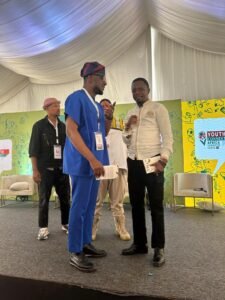
Ferdy Adimefe
The missing piece in the African creative economy: ownership
Back to the akara seller and the one thing her business lacks.
She owns her skill, but she does not own an asset. When she stops frying, the income stops. Nothing she has built can earn while she sleeps, travel without her, or pass to her children as something they own.
Why IP outlives the hustle?
Intellectual property changes that equation. A story, a character or a world can be licensed, translated, adapted and sold again and again, long after the first drawing.
Anthea Whitehead of the AAA School of Advertising put it plainly in a July 2026 column: “Africa has never had a talent problem.
It has an ownership problem.” Too often, African creatives do the work while the long-term value is owned somewhere else.
Capital is arriving in the African creative economy.
The money is starting to notice. In May 2025, Afreximbank launched a $1 billion Africa Film Fund to back the production and global distribution of African stories.
The hustle is here, and the capital is beginning to arrive. What we still need are more assets we own.
African stories are already travelling.
Some of our stories have already made the trip, and each one teaches something different.
Iwájú and Kugali: African IP on a global stage.
In 2017, Tolu Olowofoyeku, Olufikayo Adeola and Hamid Ibrahim founded Kugali, an African-owned storytelling collective. In February 2024, Iwájú, their series with Disney Animation set in a future Lagos, had its world premiere in Lagos. All six episodes launched on Disney+ the same day.
Supa Strikas: a lesson on who owns the story
South Africa’s Supa Strikas shows both the promise and the warning. The football comic grew to about 1.4 million copies a month in 16 languages. In 2019, Moonbug Entertainment acquired the franchise.
A story built on the continent can travel the world. So can its ownership.
Building The Passport of Mallam Ilia.
At Magic Carpet Studios, we started The Passport of Mallam Ilia in 2018. It is a 2D adaptation of Cyprian Ekwensi’s 1960 novel. A two-hour 2D film at 24 frames per second needs close to 173,000 drawings, and Lagos did not have enough trained animators to make them.
So we did what the tailor does with offcuts and worked with what we had. Students from Yaba College of Technology joined the team. In 2022, we launched the Magic Lab Fellowship to train more, and the Lagos State Employment Trust Fund supported 80% of that first cohort.
The film grew into a Nigeria-France co-production. Both sides brought something the other needed, and we built it together instead of one side producing for the other.
How to build IP in the African creative economy.
The akara seller already has what a founder needs: instinct, discipline and a sharp read of her market. What she was never handed was something to own. The next wave of the African creative economy can change that.
Three moves for African creators.
- Build worlds, not just jobs. A commission pays once. A character, a story universe or a format can earn for decades.
- Register, protect and license what you make. Ownership on paper is what lets an idea be sold, financed or passed on.
- Partner as a co-builder. When working with global studios, ask “what can we build together?” instead of “what can we produce for you?” Share the upside, not just the workload.
FAQ: the African creative economy
What is the African creative economy?
The African creative economy covers industries built on ideas and culture, including film, animation, music, fashion, design, games and publishing. Its long-term value sits in intellectual property, the stories, characters and brands that can be licensed and sold many times.
Why does intellectual property matter for African creators?
Intellectual property turns one piece of work into an asset that keeps earning. Without ownership, creators are paid once while others capture the value of distribution, licensing and spin-offs.
Are there examples of African IP going global?
Yes. Iwájú, created by Lagos-founded Kugali with Disney Animation, launched on Disney+ in 2024. South Africa’s Supa Strikas comic reached about 1.4 million copies a month in 16 languages.
How does the informal economy relate to the African creative economy?
Both run on the same hustle, and much creative work is also informal: unregistered, unprotected and paid once.
Why does ownership matter so much for informal creators?
Hustle only earns while you’re working, but IP keeps earning.
Can a micro-entrepreneur own intellectual property?
Yes. The answer includes simple first steps: keep records, register your brand or work where you can, and put ownership in writing.
How does moving from informal hustle to IP ownership help Africa?
More of the value stays on the continent.